
Əl Kulus: A Community Resilience Center
a path forward for our community
Our community has experienced record-breaking climate disasters, including droughts, catastrophic wildfire events (Carr Fire), floods, extreme heat and smoke exposure. These kinds of weather events are expected to increase and become more extreme. Many of us personally experienced home loss, evacuations, the ongoing public safety power shutoffs and the stress these experiences cause. We are planning to build a community resilience center to provide a safe place to access temporary resources like wi-fi, clean water and air, cooling and lodging during emergencies.
This place - Əl Kulus, Wintu for the granary, refers to traditional Wintu granaries that were used to store acorn (a primary staple food of Wintu and other northern California Native Peoples) year round. Əl Kulus will be a year-round community center as well as a community resilience center during emergencies and disasters.
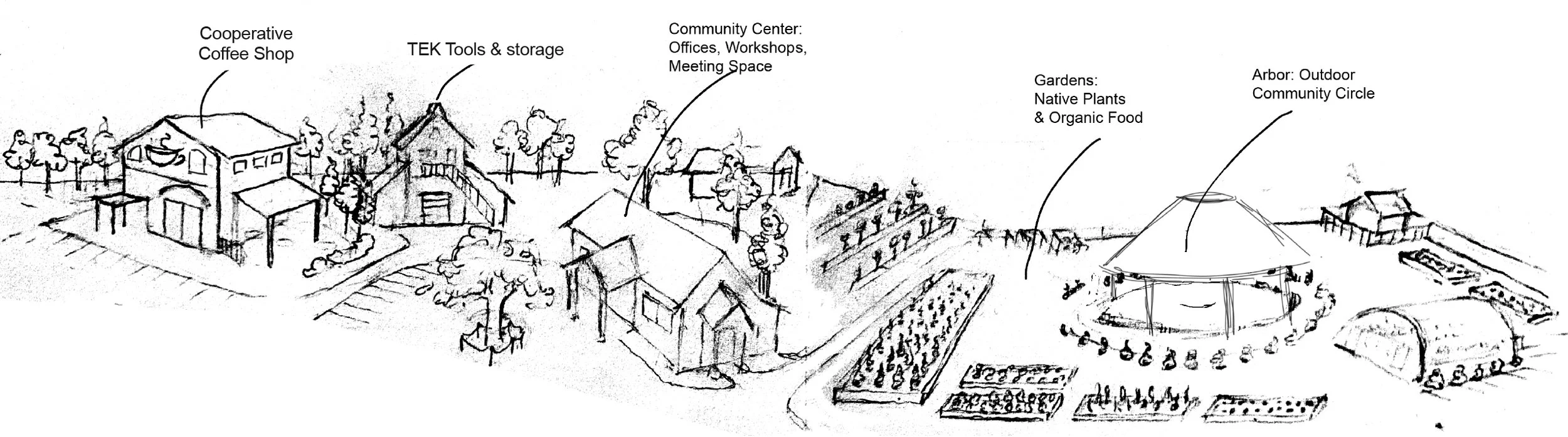
This is our initial concept sketch for Əl Kulus: A Community Resilience Center
the vision for Əl Kulus
Əl Kulus (situated in what is now known as Bella Vista) takes its name from the Wintu word for traditional acorn caches. As the acorn is central to the Wintu People, Əl Kulus aims to embody and model “Acornomics”—a sustainable, regional solidarity economy that supports social cohesion, capacity building, workforce development, climate resiliency, and community mobilization for all, while centering Wintu people in their homelands and other Indigenous Peoples, values, and knowledge. The CRC will serve as a community space designed co-creatively using culturally appropriate community assessments and evaluations to ensure inclusion and relevance specific to community needs. Native Roots Network and Co-Lab Shasta (NRN’s intercultural Solidarity Economy community) will build upon ongoing collaborative efforts to grow food sovereignty programs, grassroots civic engagement, local leadership, and climate resilience awareness/preparedness. Central to this is a traditional ecological knowledge (TEK) land crew supporting the restoration of riparian areas, woodlands and forests, helping to heal and nourish the landscapes that once nourished and healed the people.
Planning for the Community Resilience Center
Around the globe, many work to reduce the harm caused by the polycrises - economic, social and climate precarity - we know we also need to put in place new systems. Systems that rehumanize, build community and foster care. Systems and ways that are sustainable, resilient, and healthy. Systems that know Mother Earth really is our Mother. Systems that recognize and utilize our differences and harness our plurality as a strength. We are building these systems using our Acornomics framework - together.
Əl Kulus: A Community Resilience Center
Collaborative Stakeholder Structure Partners
Local Indians for Education (LIFE)
Wintu Language Circle
Wintu Tribe of Northern California
Co-Lab Shasta
United Way of Northern California
Bella Vista resident(s)
Oliview Farms

Əl Kulus: A Community Resilience Center is in a 2-year planning phase and is supported by the California Strategic Growth Council Community Resilience Center Planning grant.
“Recent and ongoing climate events and public health emergencies impact every part of California and highlight resilience opportunities for planning, preparation, and adaptation. Such impacts encompass shorter-term events like earthquakes, extreme heat, floods, mudslides, power outages and disruptions, storms, and wildfires, in addition to longer-term events like the COVID-19 pandemic, drought, rising temperatures, and sea level rise. Best available climate science projections anticipate that these climate impacts will worsen, expand, extend, and compound. In the face of these challenges, building and strengthening resilience requires investments in both physical and social infrastructure. In addition to climate resilience activities, community resilience builds ongoing social cohesion, trust, and networks.
Due to historic redlining and cycles of underinvestment, communities across California face unequal access to local resilience opportunities including: clean energy and water infrastructure, emergency response services, and public health resources. Given California’s range of geographies, biomes, diverse populations and needs, and existing infrastructure and investments, resilience will look different across the state. Robust, meaningful, culturally appropriate community engagement therefore must ensure local community priorities materialize into community-driven projects at every phase. Community resilience centers build upon these key concepts to strengthen community resilience in neighborhoods across California.”
Excerpt from California Strategic Growth Council Community Resilience Centers (CRC) Program